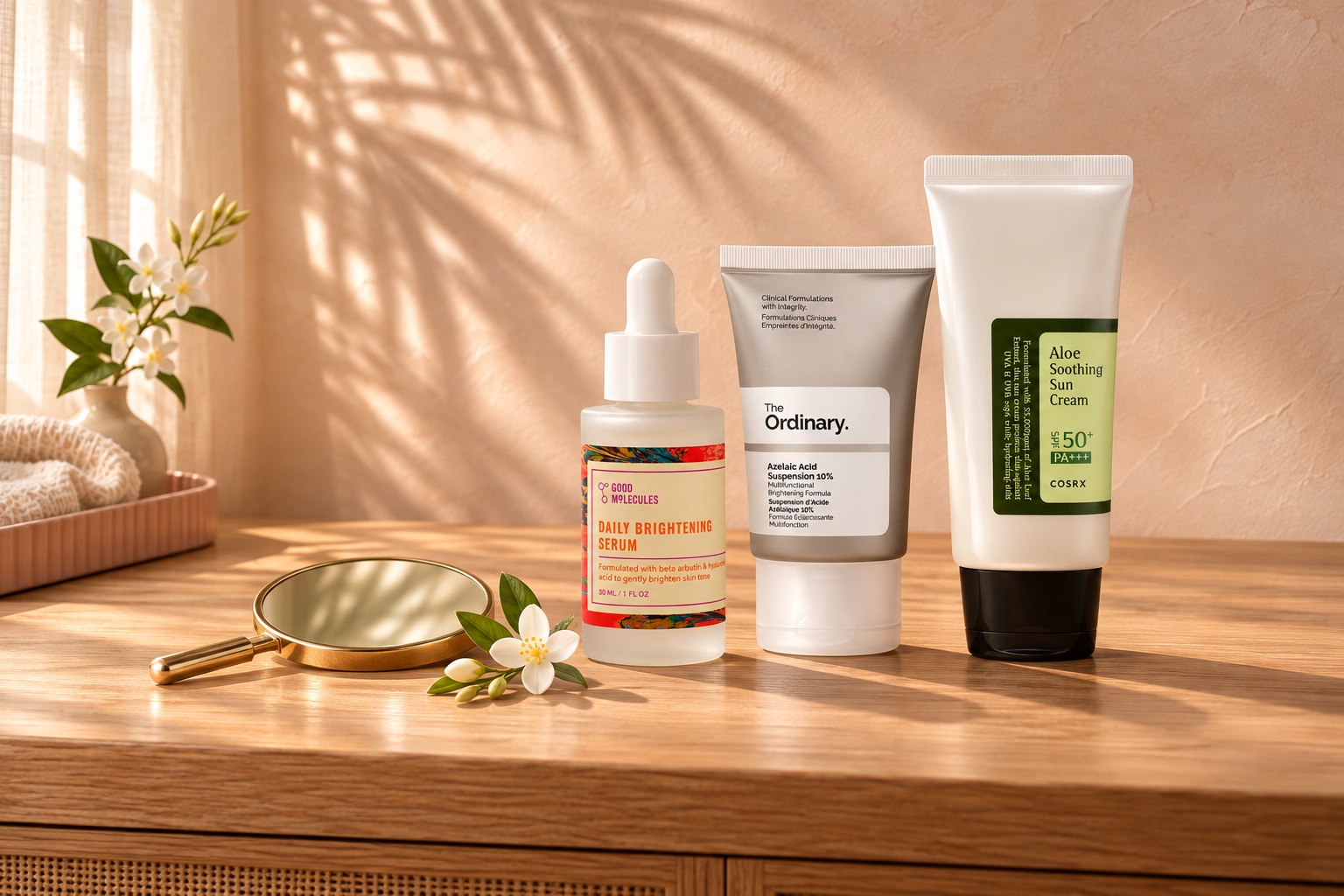
You know the pimple that lasts a week, and the mark it leaves behind that lasts three months? On brown skin, that’s not bad luck, and it doesn’t mean you have “bad skin”. It’s your melanin doing its job a little too well. And no, you don’t need a bleaching cream to fix it. Here’s what’s actually happening under your skin, and the routine that really fades it.
First, a little about melanin
Your skin colour comes from melanin, a pigment made by cells called melanocytes. They sit at the bottom of the top layer of your skin, pack melanin into tiny parcels called melanosomes, and hand those parcels to the skin cells around them.
The science: brown skin doesn’t get its colour from having more pigment cells. What differs is the melanin itself. In deeper skin tones, the melanosomes are larger and spread out one by one through the skin cells, instead of sitting in small clusters as they do in lighter skin. That’s part of what gives brown skin its beautiful depth, and its built-in sun protection. It also means your pigment cells respond strongly when something disturbs them.
Why brown skin marks so easily
Anything that inflames your skin can leave a mark behind: a pimple, a bug bite, a razor bump, eczema, a scratch, picking, scrubbing too hard, or a product that burns.
The science: when skin is inflamed, it releases chemical messengers. Those messengers tell the melanocytes to make extra melanin, and the extra pigment is left behind after the inflammation is gone. Dermatologists call this post-inflammatory hyperpigmentation, or PIH. It’s one of the most common reasons people with brown skin see a dermatologist, and acne is its number one trigger.

Brown mark or grey mark? Why some fade faster
Not all dark marks are the same. Where the extra pigment sits in your skin changes how it looks and how long it stays.

Most post-acne marks are the brown kind. That’s good news: they do fade. They just need time, protection and the right ingredients.
What makes dark marks worse
- Sun, and not just UV. Visible light, the ordinary light you can see, also darkens pigment in brown skin. In one study, visible light caused darker, longer-lasting pigmentation in deeper skin types than UV light did. Here in Jamaica, that’s a lot of light every single day.
- Picking and squeezing. More inflammation means more pigment. Every squeeze tells your skin to make a darker mark.
- Harsh scrubs and products that burn. Irritation is inflammation, so “if it burns, it’s working” works against you here.
- Hacks like lime juice and toothpaste. Both can irritate or burn the skin and leave new marks. We broke these down in 7 skincare myths we need to stop believing.
- Unlabelled bleaching creams. Some have been found to contain mercury or strong steroids, which can damage the skin and leave it patchier than before.
What actually helps
1. Sunscreen every single morning. Without it, nothing else can keep up, because the sun keeps re-darkening what you’re trying to fade. Use SPF 30 or higher, every day, even when it’s cloudy. For extra protection from visible light, a tinted sunscreen with iron oxides helps. If you can’t find a tint that matches you, wear your usual sunscreen and put a foundation or tinted product with iron oxides on top. Our guide to sunscreen on deep skin tones has picks that leave no white cast.
2. Calm the cause first. If breakouts keep coming, new marks keep forming, and no fading product can keep up. Treat the acne (or the razor bumps, or the eczema) and the marks have a chance to clear. Start with why you keep breaking out.
3. Choose ingredients with research behind them.
- Azelaic acid: calms breakouts and fades marks at the same time. A 24-week trial in people with darker skin found it lightened dark patches significantly more than a plain cream.
- Niacinamide: slows the hand-off of pigment parcels to your skin cells. A study found a 5% niacinamide moisturiser reduced dark patches within four weeks. It hasn’t been studied much in deeper skin tones specifically, but it’s gentle, so it’s a great place to start.
- Arbutin: a brightener that slows down the enzyme your skin uses to make melanin.
- Retinoids (vitamin A): speed up skin renewal, so pigmented cells shed sooner. They have good studies in brown skin, but they can irritate, and irritation means more marks. Start low, two or three nights a week.
- Gentle exfoliating acids: a mild glycolic acid toner a few nights a week helps lift dull, marked surface cells. Keep it gentle. Strong peels at home can backfire on brown skin.
Not sure which one to start with? Our post on niacinamide vs azelaic acid helps you choose.
4. Be patient and consistent. Surface marks usually take weeks to months to fade, even with the right routine. Pick one brightening product, use it every day, and give it at least 8 to 12 weeks before deciding it doesn’t work. Switching every two weeks starts the clock over.
Is it a dark mark, or is it melasma?
Melasma is a different condition. It shows up as larger, smudgy patches, usually on both cheeks, the forehead or above the lip, often in the same pattern on both sides of the face. It’s linked to hormones (pregnancy, birth control) as well as sun and heat, and it tends to come back. If your dark patches weren’t left behind by a pimple or a scratch, it could be melasma, and a dermatologist can confirm it and guide treatment.
When to see a dermatologist
- Your marks haven’t faded at all after 6 months of a steady routine with daily sunscreen.
- The marks are grey or blue-grey.
- The patches look like melasma.
- A spot is changing in size, shape or colour, itches or bleeds. Always get that checked.
Your dark-mark routine, simplified
- Morning: gentle cleanser, niacinamide or arbutin serum, moisturiser, sunscreen (tinted if you can).
- Night: gentle cleanser, azelaic acid or a retinoid (not both on the same night when you’re starting), moisturiser.
- Two or three nights a week: glycolic acid toner, on nights you skip the retinoid.
- Always: hands off. Use a pimple patch if you can’t stop picking.
Want a routine made for your skin? Book a free consultation and we’ll put one together with you, or try our routine builder.
Shop the post: The Refine & Brighten Treatment Set · Azelaic Acid Suspension 10% · Niacinamide 10% + Zinc 1% · Good Molecules Daily Brightening Serum · Granactive Retinoid 2% Emulsion · Glycolic Acid 7% Toner · Book a free consultation
Sources
- How dark marks form, brown vs grey marks, and which ingredients help: Davis & Callender, Postinflammatory hyperpigmentation: a review in skin of color, Journal of Clinical and Aesthetic Dermatology, 2010
- Larger, spread-out melanin parcels in deeper skin: Thong et al., The patterns of melanosome distribution in keratinocytes of human skin, British Journal of Dermatology, 2003
- Visible light and pigment in deeper skin: Mahmoud et al., Impact of long-wavelength UVA and visible light on melanocompetent skin, Journal of Investigative Dermatology, 2010
- Tinted sunscreen and iron oxides: Tinted sunscreen does something regular sun protection can’t, NPR, 2025
- Azelaic acid in darker skin: Lowe et al., Azelaic acid 20% cream for facial hyperpigmentation in darker-skinned patients, Clinical Therapeutics, 1998
- Niacinamide: Hakozaki et al., The effect of niacinamide on reducing cutaneous pigmentation, British Journal of Dermatology, 2002
- Retinoids, peels and sun protection for dark marks: Treatment of post-inflammatory hyperpigmentation in skin of colour: a systematic review, Journal of Cutaneous Medicine and Surgery, 2024
- Melasma: Melasma, American Academy of Dermatology